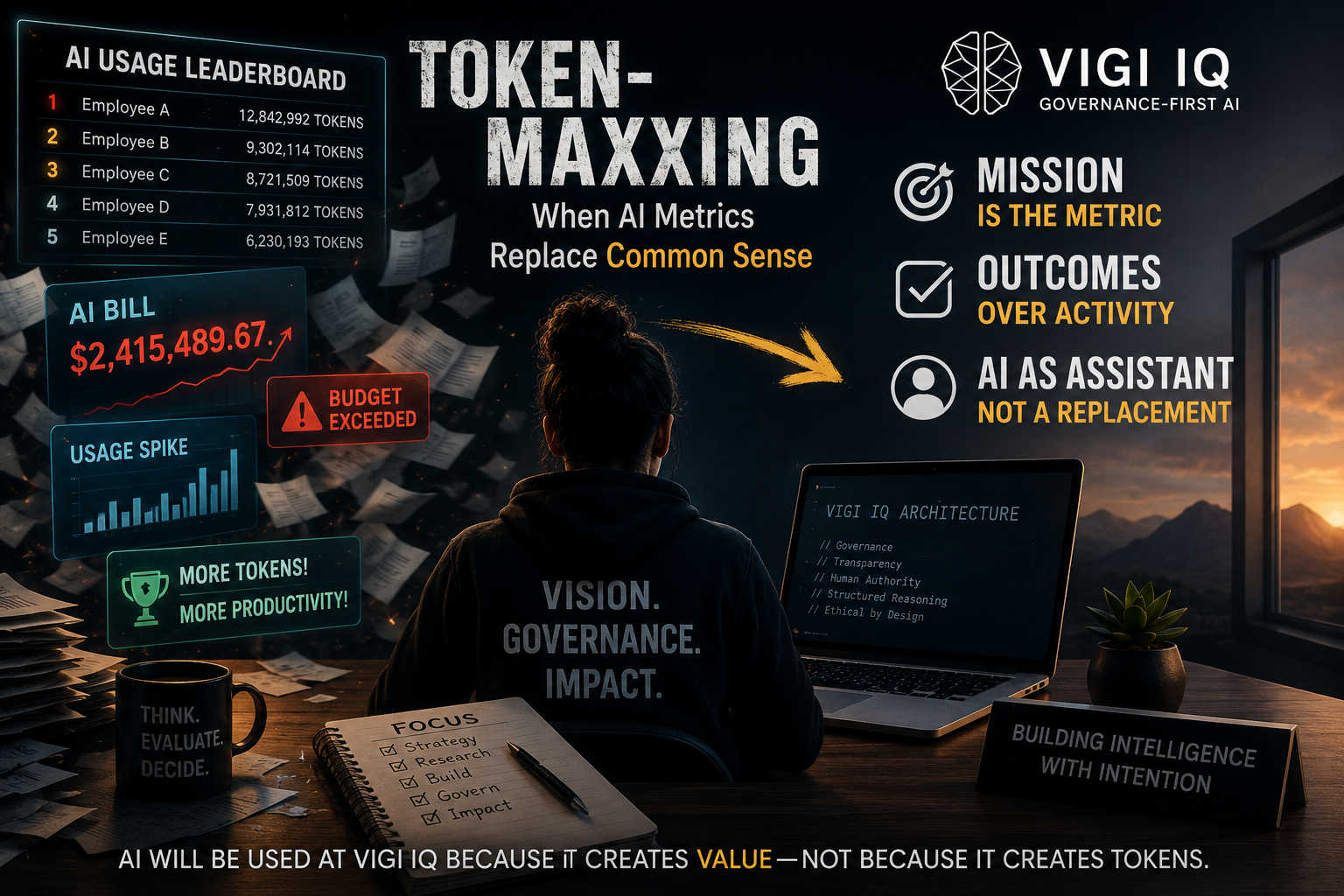
Token-Maxxing: When AI Metrics Replace Common Sense
The AI industry has developed an unhealthy obsession with a metric that should have never become a goal: usage. More tokens. More prompts. More AI interactions. More AI-generated code. More AI-generated content.
The assumption seems to be that greater AI usage automatically translates into greater productivity. It does not. In many cases, it translates into greater waste.
Recently, reports have emerged of organizations struggling with unexpectedly high AI costs after encouraging widespread adoption. Some companies even experimented with AI usage leaderboards, effectively turning AI consumption into a competition.
I find this fascinating. The outcome is not at all surprising and was very predictable. The moment you create a leaderboard, people stop optimizing for the mission and start optimizing for the score. This is not an AI problem. It is an incentive problem.
The Mission Is the Metric
One of the most common mistakes organizations make is confusing activity with value. An employee who sends 1,000 prompts is not necessarily more productive than an employee who sends 10. An engineer who consumes millions of tokens is not automatically producing better work than one who consumes significantly fewer. An organization that spends more money on AI is not automatically becoming more intelligent.
The purpose of a tool is not to be used. The purpose of a tool is to accomplish something. The mission is the metric. Outcomes are the metric. Competence is the metric.
Everything else is secondary.
Goodhart's Law and the AI Industry
There is a well-known principle in organizational behavior:
"When a measure becomes a target, it ceases to be a good measure."
The AI industry is currently demonstrating this principle in real time. If organizations reward AI usage, employees will maximize AI usage. If organizations reward token consumption, employees will maximize token consumption. If organizations reward leaderboard position, employees will maximize leaderboard position.
None of those things guarantee better outcomes.
In fact, they often create the opposite effect. The metric becomes the mission. The mission gets forgotten.
Intelligence Is Not a Utility
Another trend that concerns me is the growing assumption that intelligence should become a metered utility. The conversation increasingly revolves around token consumption, usage quotas, and compute budgets.
I understand the economics. I build AI systems myself. But I am not particularly interested in a future where intelligence becomes something entirely controlled by a small number of centralized providers and consumed through endless metering.
I believe local capability matters, ownership matters, human expertise matters, and most importantly: HUMAN JUDGEMENT MATTERS.
My Own Experience
I believe in transparency. There is no way I would have built VIGI IQ and its intellectual property without AI. Sure, I think I could have "eventually" done it...but it would have taken significantly longer.
The conception of VIGI IQ began yrs ago. The company itself represents more than five years of thought, research, learning, refinement, and creativity. The difference is that AI allowed me to compress execution. Within a matter of months, I was able to move from ideas and architectural concepts to working prototypes, public demonstrations, research publications, governance frameworks, and the early stages of a complete ecosystem.
However, there is an important detail that often gets lost in these discussions. My AI spending is relatively small. I am not spending thousands of dollars per month. I am not consuming enterprise-scale compute.
I am not "token-maxxing."
Most months, my AI costs are roughly equivalent to a streaming subscription.The reason is simple. I use AI as an assistant. Not as a replacement for thinking. The vision, mission and decisions are all mine. AI helps me move faster, but it does not determine where I am going.
Competence Cannot Be Outsourced
The most important lesson I have learned is that AI does not eliminate the need for expertise. IT AMPLIFIES IT. To use AI effectively, a person must still understand enough about the problem to evaluate whether the output is useful, accurate, ethical, and aligned with the intended objective.
The rise of AI is not exposing who can generate content. It is exposing who can evaluate it. That distinction matters. A person who cannot identify an incorrect output is not gaining intelligence through AI. They are gaining dependency.
The Future Belongs to the Disciplined
I am optimistic about AI. I build AI. I research AI. I believe it will transform industries. But I also believe that many organizations are learning an important lesson:
More AI does not automatically create more value. More tokens do not automatically create more productivity. More usage does not automatically create more intelligence. The organizations that thrive will not be the ones that maximize AI consumption. They will be the ones that maximize outcomes.
AI is a tool. The mission comes first. Always.
~ Chanel A. Henry, MS/PhD(c) Founder, VIGI IQ
Test VIQ™ Phase 4: viq.vigiiq.com (viqdemophase4.streamlit.app)
Research at VIGI IQ: vigiiq.com/research
Learn more: vigiiq.com | vigiiq.com/labs
© 2020–2026 Chanel A. Henry & VIGI IQ, LLC - All Rights Reserved | Patent Pending