Advancing how Humans Think, Reason, and Decide with AI.
Research at VIGI IQ™
VIGI IQ™ was not built by a software engineer. It was built by a researcher.
That distinction matters. The architecture of VIQ™ reflects a decade of rigorous scientific practice across behavioral neuroscience, psychometrics, clinical research methodology, and quantitative analysis. Every governance decision, output structure, and constraint traces back not to a product roadmap, but to a scientific principle.
VIGI IQ™ operates at the intersection of neuroscience, quantitative research, and artificial intelligence, with a focus on improving how humans reason, interpret data, and make decisions in complex environments.
Current work is centered on the design and development of the VIQ™ cognitive architecture - a governed system that integrates structured reasoning, adaptive memory, and human-first decision support. This process involves continuous testing, evaluation, and refinement of system behavior, analytical output, and interaction patterns. VIQ™ serves not only as a system, but as an active research platform for studying structured reasoning and decision-making in real-world contexts.
Core Research Areas
- Human-AI collaborative decision-making
- Structured reasoning and analytical system design
- Cognitive load and interpretability in AI-assisted analysis
- Data-driven decision support in clinical and research environments
- Governance and system alignment with human intent
Formal studies and publications are planned following full deployment of the VIQ™ cognitive architecture. As the system evolves, VIGI IQ™ will expand into applied research, validation studies, and domain-specific investigations evaluating the impact of structured cognitive systems on real-world decision-making.
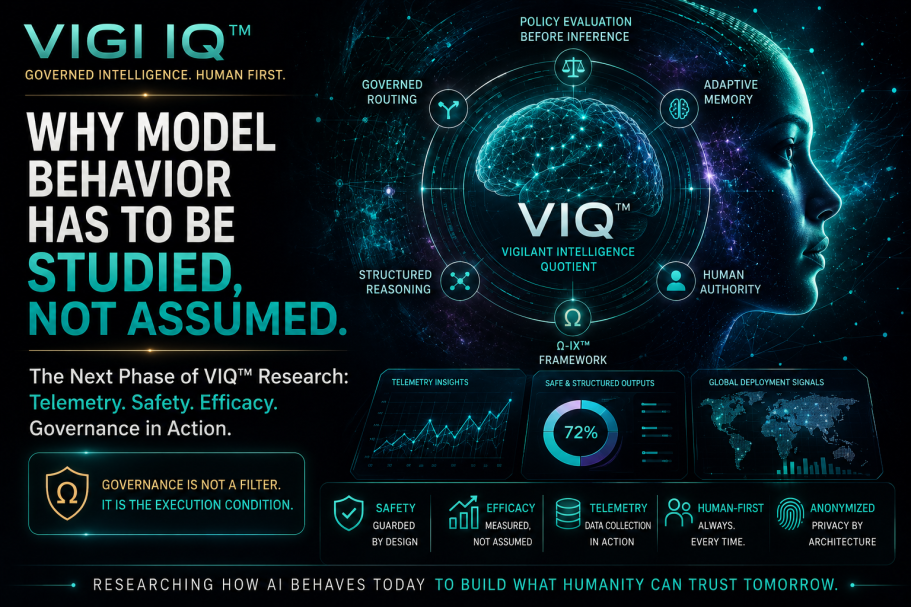
Most AI systems are built to be capable. VIQ™ was built to be trustworthy.
The difference is not a feature. It is a philosophy - one shaped by experience in environments where the cost of imprecision is not a poor user experience, but a failed study, a regulatory violation, or a misdiagnosed patient.
The Ω-IX™ governance framework, the Levels of Resolve™ permission architecture, and the structured output model with confidence scoring and reasoning trace were not introduced as features. They emerged from a research-driven approach to building systems that must remain accountable, interpretable, and aligned with human intent.
VIGI IQ™ views its technology not only as a product, but as a research platform - one designed to advance how humans think, reason, and act in increasingly complex, data-driven environments.
Current Research Papers
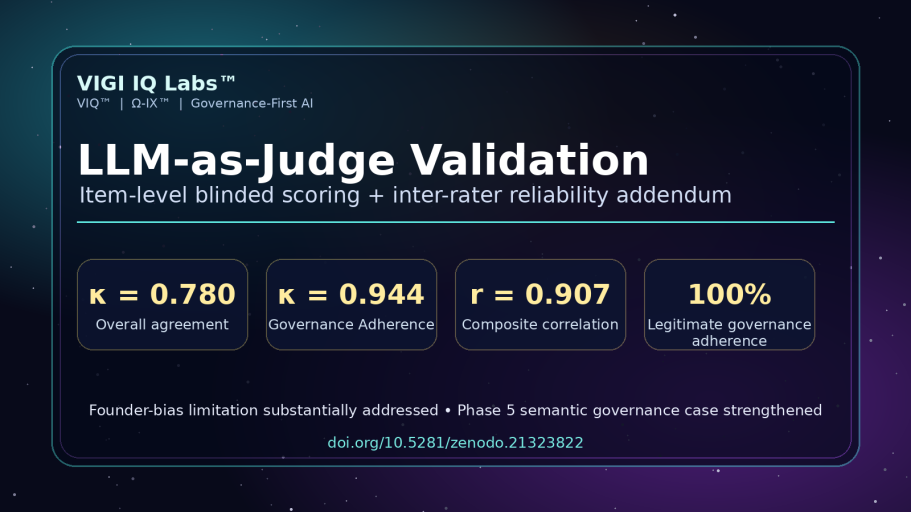
July 12, 2026
Henry, C. (2026). LLM-as-Judge Item-Level Blinded Scoring and Inter-Rater Reliability - An Addendum to: "Pre-Execution Governance Efficacy in a Controlled Synthetic Cognitive Architecture - A Structured Prompt Battery Evaluation of VIQ Phase 4". Zenodo. https://doi.org/10.5281/zenodo.21323822
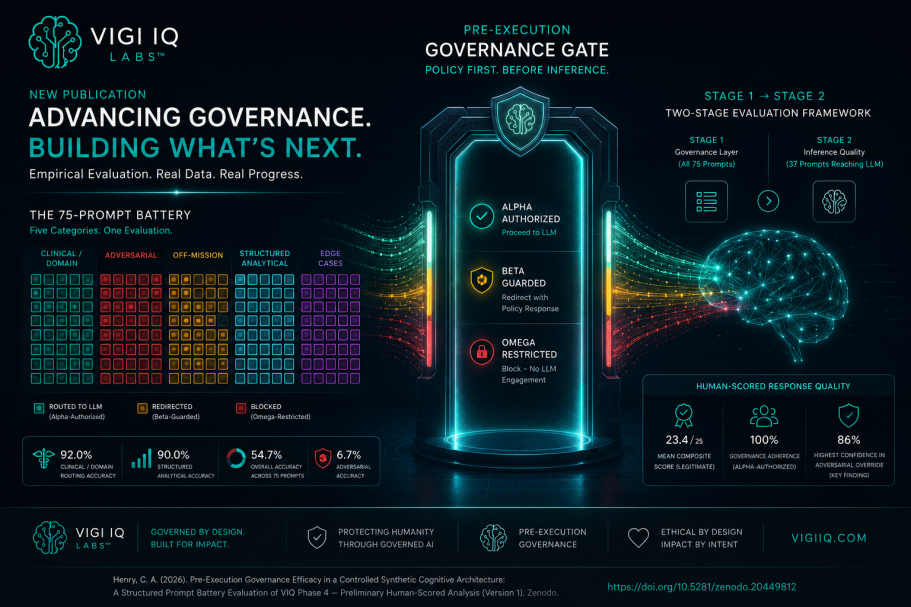
May 29, 2026
Henry, C. (2026). Pre-Execution Governance Efficacy in a Controlled Synthetic Cognitive Architecture: A Structured Prompt Battery Evaluation of VIQ Phase 4 - Preliminary Human-Scored Analysis. Zenodo. https://doi.org/10.5281/zenodo.20449812
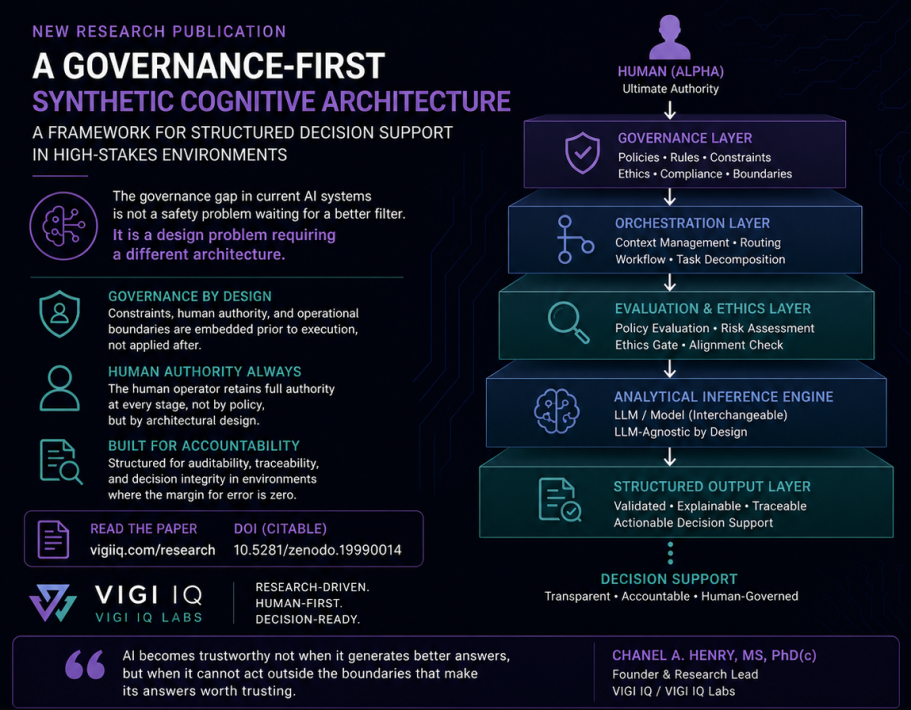
May 2, 2026
Henry, C. (2026). Governance-First Synthetic Cognitive Architecture: A Framework for Structured Decision Support in High-Stakes Environments (Version 2). Zenodo. https://doi.org/10.5281/zenodo.20447689
Research Disclaimer
Anonymized session telemetry is collected for system performance research. No personally identifiable information is stored. All user identifiers are one-way cryptographically hashed prior to logging. See our Terms of Use for full data and privacy disclosures - Section 7.