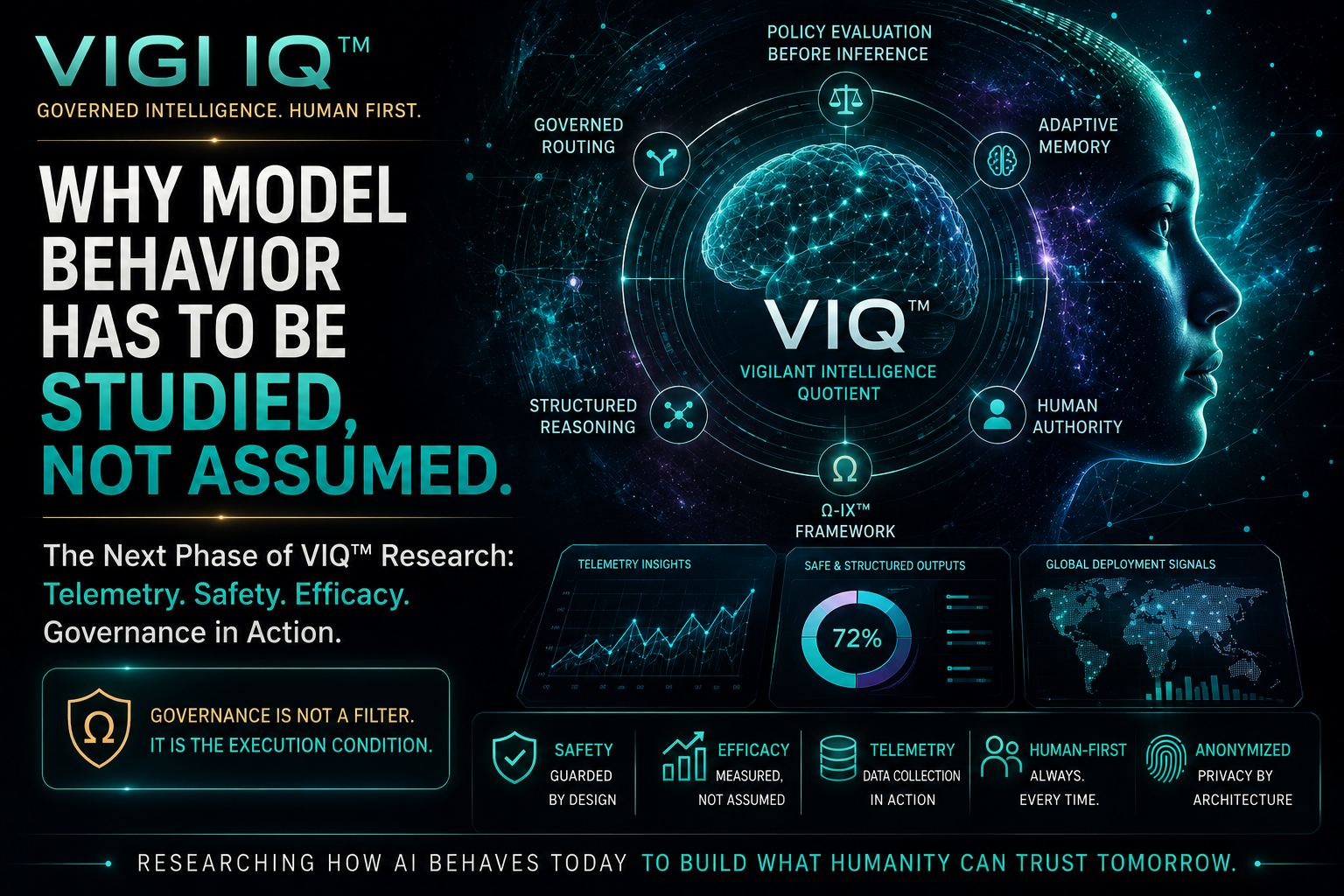
Why Model Behavior Has to Be Studied, Not Assumed
Safety, efficacy, and the next phase of VIQ™ research
Artificial intelligence systems are increasingly being placed into environments where their outputs can influence human judgment, professional workflows, research interpretation, and decision-making. That reality creates a responsibility that goes beyond building systems that appear useful.
We have to study how they behave.
Not just whether they produce fluent answers.
Not just whether users like the interface.
Not just whether the output sounds confident.
We need to understand how AI systems respond under constraints, how they route different kinds of prompts, how often governance mechanisms activate, how outputs are structured, where uncertainty appears, and whether the system behaves consistently within the boundaries it was designed to respect.
That is the foundation of my current research direction at VIGI IQ™.
From architecture to behavioral research
My first paper, “Governance-First Synthetic Cognitive Architecture: A Framework for Structured Decision Support in High-Stakes Environments,” introduced the conceptual foundation behind VIQ™: a governance-first cognitive architecture designed for structured decision support.
That paper was not an empirical validation study. It did not claim clinical validation, benchmark superiority, or real-world deployment readiness. Its purpose was architectural: to define why governance should occur before inference, not after output generation.
In other words, the paper asked:
What would an AI architecture look like if safety, structure, uncertainty, and human authority were not added after the fact; but designed into the system from the beginning?
That question led directly into the next phase of work.
The current public VIQ™ demo gives us an opportunity to observe how a bounded governance-first system behaves in real interaction.
Why model behavior matters
A model’s behavior is not defined only by what it can generate. It is also defined by what it refuses, redirects, qualifies, structures, and routes.
That matters because high-stakes environments do not simply need “answers.” They need systems that can behave appropriately under constraints.
A useful AI system should be evaluated on questions like:
Does it recognize when a prompt requires caution?
Does it route analytical prompts differently from casual or off-mission prompts?
Does it preserve human authority in the interaction?
Does it structure its outputs in a way that supports review and decision-making?
Does it express uncertainty rather than hiding it behind confident language?
Does its governance layer activate before risky output generation occurs?
These are not cosmetic questions. They are safety and efficacy questions.
For VIQ™, efficacy does not mean “can the system answer anything?” It means: does the system perform the governed function it was designed to perform?
That is a very different standard.
Safety is not only content moderation
When people talk about AI safety, the conversation often focuses on harmful content, misuse, or policy violations. Those are important. But in professional and research environments, safety also includes decision integrity.
A system can be unsafe even if it never produces obviously harmful content.
It can be unsafe if it gives overconfident outputs.
It can be unsafe if it fails to distinguish speculation from analysis.
It can be unsafe if it treats high-stakes questions like casual conversation.
It can be unsafe if it hides uncertainty.
It can be unsafe if users cannot understand why the system responded the way it did.
This is why I focus on governance-first architecture. The goal is not merely to block bad outputs. The goal is to shape the conditions under which outputs are produced in the first place.
Governance should not be a cleanup step.
Governance should be an execution condition.
The current VIQ™ telemetry study
The current VIQ™ public demo is now being used as the basis for a bounded telemetry research study.
This does not mean collecting sensitive personal information. The purpose is not to identify users or monitor individual behavior. The purpose is to evaluate system-level behavioral patterns inside the demo environment.
The telemetry layer is designed to capture signals such as:
Prompt classification patterns
Routing decisions
Governance trigger events
Mode usage
Structured output success
Response category distribution
Session-level interaction patterns
Anonymized user hashes for access and usage tracking
These signals help answer a central research question:
Does a governance-first routing architecture produce observable, measurable patterns of safer and more structured AI behavior in a bounded public deployment?
That question will guide my next planned research study:
“Beyond Post-Hoc Filtering: Evaluating the Efficacy of Governance-First AI Routing in a Bounded Public Deployment.”
This upcoming study moves from conceptual architecture into empirical observation.
The first paper defined the framework.
The next study examines how the framework behaves.
Testing safety and efficacy in context
One of the most important lessons in AI evaluation is that systems do not fail only in the lab. They fail in context.
They fail when users phrase things unexpectedly.
They fail when prompts are ambiguous.
They fail when safety rules are too broad.
They fail when safety rules are too narrow.
They fail when the system does not understand the difference between a legitimate analytical request and a request that should be redirected or constrained.
That is why real interaction data matters.
A governance system cannot be evaluated only by describing its intended design. It has to be observed under use.
For example, one type of research question may involve whether legitimate analytical prompts are being incorrectly blocked. Another may involve whether risky prompts are being correctly routed into safer response pathways. Another may involve whether structured outputs remain consistent across different prompt types and modes.
This is the kind of behavioral evidence that can help determine whether a system is functioning as designed.
Why this matters for high-stakes AI
The long-term vision for VIQ™ is not to create another chatbot. It is to build governed cognitive infrastructure for decision environments where structure, transparency, and human authority matter.
That includes clinical research, regulatory compliance, psychometrics, AI safety evaluation, public health, and other domains where the cost of unreliable output can be significant.
In those environments, it is not enough for an AI system to be impressive.
It has to be inspectable.
It has to be bounded.
It has to be accountable to human authority.
It has to know when not to proceed.
It has to preserve uncertainty.
It has to support decisions without replacing the person responsible for making them.
This is why safety and efficacy research matters.
Not as a marketing claim.
Not as a checkbox.
As an ongoing scientific requirement.
From prototype to evidence
VIQ™ is currently in a public demo phase. That distinction matters.
The public demo is not the full cognitive architecture. It is a bounded window into selected capabilities: governed routing, structured reasoning, adaptive memory, confidence scoring, reasoning trace, and controlled interaction design.
But even a bounded demo can produce meaningful research signals.
The telemetry study allows us to examine whether governance-first architecture can be measured behaviorally. It creates a bridge between architectural theory and operational evidence.
That bridge is where the next phase of AI safety research needs to go.
We cannot keep treating model behavior as something we notice only after deployment.
We have to study it deliberately.
We have to instrument it responsibly.
We have to test whether our safety designs actually work.
That is the purpose of this next phase of VIQ™ research.
Closing thought
The future of AI will not be defined only by larger models or more powerful outputs.
It will be defined by whether intelligent systems can be trusted under pressure, under uncertainty, and inside the real conditions where humans make consequential decisions.
At VIGI IQ™, the work is moving in that direction:
From architecture.
To prototype.
To telemetry.
To evidence.
Because model behavior should not be assumed.
It should be studied.
~ Chanel A. Henry, MS/PhD(c) Founder, VIGI IQ
Test VIQ™ Phase 4: viq.vigiiq.com (viqdemophase4.streamlit.app)
Research at VIGI IQ: vigiiq.com/research
Learn more: vigiiq.com | vigiiq.com/labs
© 2020–2026 Chanel A. Henry & VIGI IQ, LLC - All Rights Reserved | Patent Pending