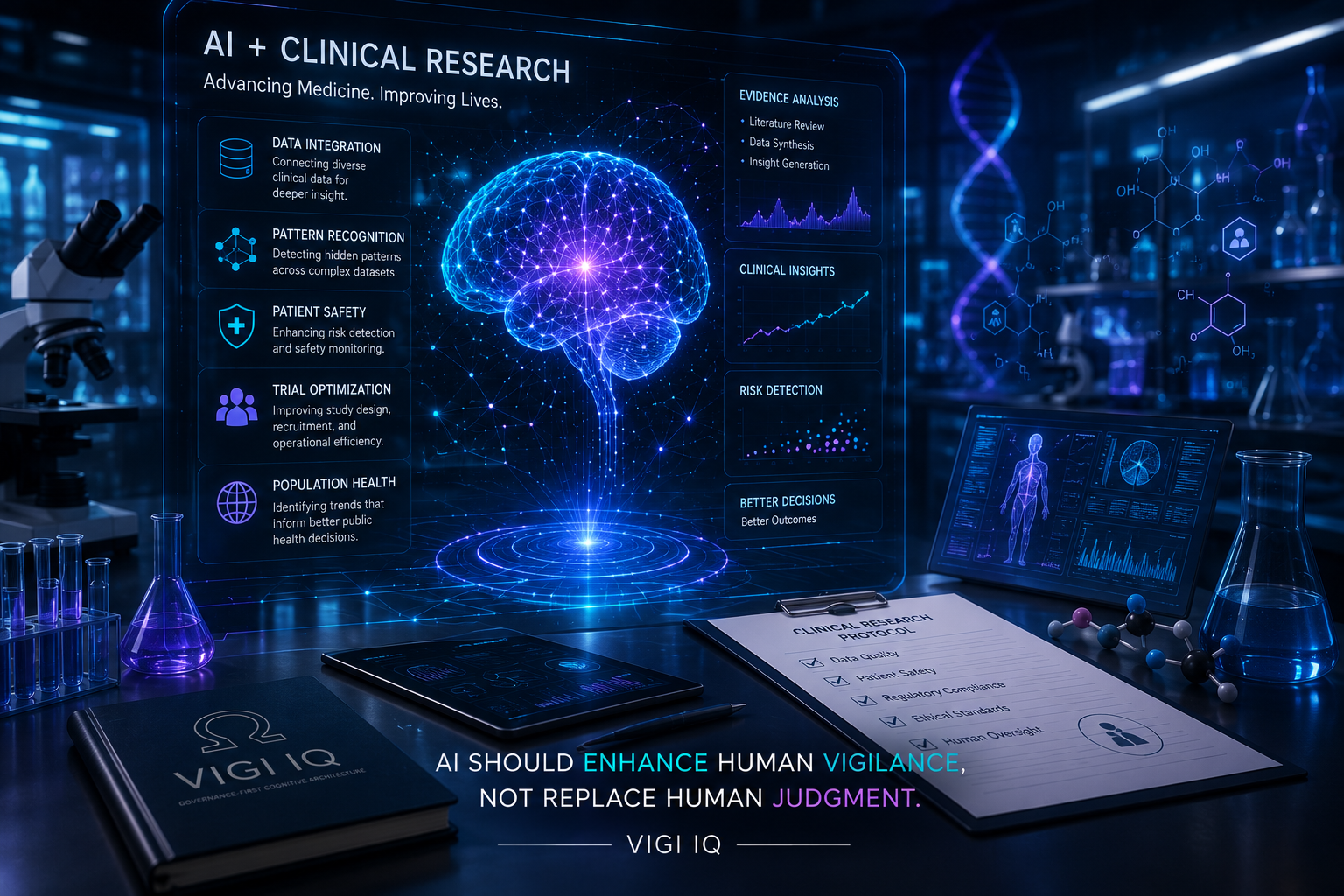
AI’s Expansion Into Clinical Research Should Excite Us
Artificial intelligence is moving beyond general-purpose assistants and enterprise productivity tools. Increasingly, the industry is turning its attention toward healthcare, medicine, clinical research, and the complex systems that support them.
I am genuinely thrilled by this development.
Clinical research is one of the most consequential areas in which AI can be applied. It is also one of the most difficult. The work involves vulnerable populations, complicated regulatory environments, large volumes of heterogeneous data, and decisions that can directly affect patient safety and public health.
That combination creates enormous opportunity. It also demands discipline.
The greatest value of AI in clinical research will not come from replacing physicians, scientists, clinical investigators, or regulatory professionals. It will come from helping them work with greater speed, consistency, vigilance, and analytical depth.
AI can help researchers organize complex evidence, identify patterns across large datasets, detect inconsistencies, support literature review, improve study planning, strengthen trial operations, and surface questions that may otherwise be missed.
It may also improve how clinical information is translated across teams. Research programs often involve investigators, coordinators, psychometricians, statisticians, laboratory personnel, data managers, sponsors, regulators, and healthcare professionals. Each group may interpret risk, evidence, and operational priorities differently.
A well-designed AI system can help structure that information so that teams are not merely receiving more data, but gaining better insight from it.
That distinction matters.
Clinical research does not suffer from a lack of information. It often suffers from fragmented information, inconsistent interpretation, delayed escalation, and difficulty separating meaningful signals from administrative noise.
AI has the potential to help address those problems.
Better Data Can Support Better Decisions
Data quality is foundational to clinical research.
An advanced model may be capable of identifying sophisticated patterns, but its output will only be as reliable as the data, governance, and context surrounding it. Poor documentation, inconsistent assessments, missing variables, biased samples, and weak operational controls can undermine even the most technically impressive system.
AI should therefore be used not only to analyze data, but also to strengthen the systems through which data is collected, reviewed, interpreted, and validated.
This could include identifying unusual response patterns, detecting discrepancies between records, flagging missing documentation, evaluating protocol consistency, and helping research teams determine when a finding requires additional human review.
The objective should not be to allow an algorithm to make an unquestioned determination.
The objective should be to help qualified professionals see more clearly.
Patient Safety Must Remain Central
Clinical research involves real people, not abstract datasets.
Participants may be experiencing serious illness, cognitive impairment, psychiatric symptoms, physical pain, financial vulnerability, or limited access to care. Any AI system operating in this environment must recognize that patient safety is not an optional feature added after development.
It must shape the architecture from the beginning.
Systems used in clinical and medical settings should have defined boundaries, traceable decision pathways, calibrated confidence, privacy protections, and clear escalation procedures. They should also distinguish between providing structured analytical support and making clinical decisions that remain the responsibility of licensed and authorized professionals.
This is where governance becomes essential.
The question is not simply whether an AI system can produce an answer.
The more important questions are:
Was the system authorized to perform that task?
Was the relevant evidence complete?
Were the appropriate clinical and regulatory constraints applied?
Was uncertainty communicated accurately?
Should a human expert review the result before any action is taken?
In high-stakes environments, intelligence without governance can become another source of risk.
AI Can Strengthen Public Health
The potential impact extends beyond individual clinical trials.
AI may help public-health professionals identify emerging patterns, examine disparities, improve resource allocation, evaluate intervention outcomes, and understand how biological, behavioral, environmental, and social factors interact across populations.
It could help connect information that currently exists in separate systems and disciplines.
That matters because public-health challenges rarely emerge from one variable. They develop through complex interactions among healthcare access, geography, economics, behavior, environment, policy, and disease burden.
AI is particularly useful when the volume and complexity of those relationships exceed what any individual person can efficiently process.
But again, the purpose should not be to remove human judgment.
It should be to improve the quality of the judgment humans are able to exercise.
This Is Where My Own Work Lives
I have spent years on both sides of this problem before AI made it urgent.
Long before I built anything, I was administering standardized psychometric assessments to cognitively vulnerable populations in dementia trials, working under GCP, HIPAA, and IRB oversight, watching firsthand how fragile good clinical judgment becomes when documentation is inconsistent or escalation happens too late. That experience is why "governance from the beginning" is not an abstract principle to me. I have sat with the consequences of getting it wrong before any model was involved.
That is the problem I set out to solve when I began designing a governance-first cognitive architecture in 2020, and it is what I have spent the last two years building and empirically testing: a system where policy, boundaries, and escalation are evaluated before a model ever generates a response, not filtered afterward. The published results validate the core idea while being honest about where a first-generation implementation still falls short. That honesty is part of the discipline this field needs. A governance claim without a documented failure mode is not a governance claim; it is marketing.
The Industry Must Build Carefully
I am encouraged that major technology companies are increasingly recognizing the importance of clinical, medical, and scientific applications.
However, entering these fields requires more than computational scale.
It requires domain expertise, clinical judgment, regulatory awareness, representative data, privacy protection, transparent evaluation, and a serious understanding of the consequences of failure.
Healthcare cannot become another environment in which products are deployed first and governed later.
Clinical AI must be evaluated not only for accuracy, but also for boundary adherence, reliability under uncertainty, behavioral consistency, data provenance, and the ability to defer appropriately to human authority.
The companies that succeed in this space will not simply build the most powerful systems.
They will build systems that professionals, researchers, patients, and institutions can responsibly trust.
A Future Worth Building
I believe AI can meaningfully accelerate clinical research, strengthen medicine, and improve public health.
It can help researchers reason across larger bodies of evidence. It can improve how teams identify risk. It can support more structured decision-making, reduce preventable errors, and help professionals spend less time managing fragmented information.
But progress should not be measured only by how much work AI can perform.
It should also be measured by whether the technology improves the safety, clarity, accountability, and quality of human decisions.
That is the future of clinical AI that excites me most.
Not artificial intelligence replacing the people responsible for science, medicine, and patient care.
Artificial intelligence helping them become more vigilant, informed, and effective.
AI should enhance human vigilance, not replace human judgment.
~ Chanel A. Henry, MS/PhD(c) Founder, VIGI IQ
Test VIQ™ Phase 4: viq.vigiiq.com (viqdemophase4.streamlit.app)
Research at VIGI IQ: vigiiq.com/research
Learn more: vigiiq.com | vigiiq.com/labs
© 2020–2026 Chanel A. Henry & VIGI IQ, LLC - All Rights Reserved | Patent Pending