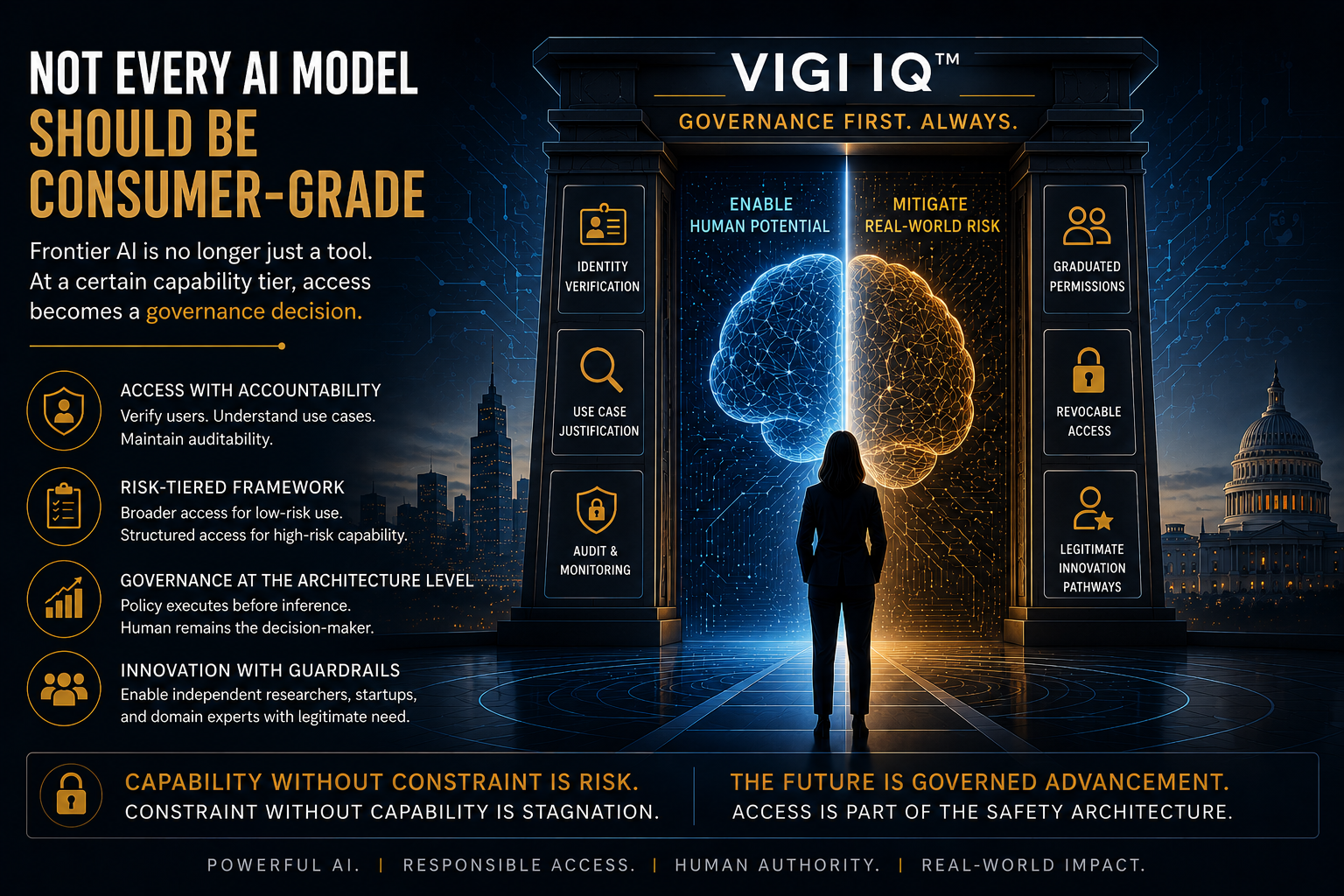
Not Every AI Model Should Be Consumer-Grade
Fable was pulled from public access within days of launch.
According to Axios, Anthropic's Fable 5, described as a general-use version of its more advanced Mythos model, became the subject of urgent government concern after reports that another company had been able to jailbreak Mythos in a way that raised national security alarms. The Commerce Department then moved to subject Mythos 5 and Fable 5 to export controls, including restrictions involving foreign persons, and Anthropic ultimately cut off access for all customers while it worked through compliance.
I am not surprised.
I have spent years building a governance-first AI architecture precisely because I saw this category of problem coming. Not this specific incident, but this kind of incident: the moment when a system becomes capable enough that unrestricted public access is no longer simply a consumer decision. It becomes a governance decision.
We have arrived at that moment.
The public conversation tends to treat AI access as a binary: open or closed. Either everyone gets everything, or only large institutions do. That framing is too simple, and it leads to exactly the kind of crisis we are watching unfold now.
Access is not the only principle that matters.
At a certain capability tier, AI is no longer a productivity tool. It becomes an amplifier: of technical skill, strategic reasoning, cyber capability, persuasion, and operational planning. When a system reaches that level, the question changes. It is no longer "should people be allowed to use AI?" It is "should every capability tier be treated like a public app?"
My answer is no.
Most people do not need access to the highest-risk frontier model to draft an email, summarize a document, write code, study for an exam, or build a business. The AI systems already widely available are powerful enough for most consumer and professional use cases. The marginal utility of frontier access for ordinary tasks is small. The marginal risk is not.
This is where the conversation about verification becomes important, and where it tends to go wrong.
The instinct to frame verification as surveillance or exclusion is understandable. Nobody wants to justify themselves to use a tool. But that framing misses the point for systems at the frontier. Know-your-customer and know-your-business processes are not attacks on innovation. They are accountability mechanisms. And accountability mechanisms are what allow powerful systems to exist in the world at all.
We already accept this logic in every other high-stakes domain. Not everyone can prescribe medication. Not everyone can access classified systems. Not everyone can work with dangerous biological agents without regulatory oversight. These controls exist not because the people excluded are untrustworthy, but because the tools themselves have consequences that extend beyond the individual user.
A reasonable access framework for frontier AI looks something like this: identity or organizational verification for the highest capability tiers; use-case justification for sensitive access; audit logs and monitored workflows; graduated permissions based on demonstrated need; revocable access for misuse; and protected pathways for independent researchers, startups, and specialized domain experts who have legitimate need but are not large corporations.
That last point matters. The goal is structured access based on risk, not gatekeeping for its own sake. An independent researcher with a legitimate use case should not be locked out simply because they lack institutional affiliation. The framework should be proportional: broad access where risk is low, structured access where risk is high.
The deeper issue is architectural.
AI safety cannot happen only after a model produces a harmful output. A content filter on the back end of a system that was designed without governance constraints is not safety. It is damage control.
Safety has to be built into the architecture of access, routing, permissions, outputs, monitoring, and human authority; before the model ever generates a response. The human has to remain the decision-maker. The model has to remain the instrument.
This is the principle I have been building toward since 2020, when I started designing what eventually became VIQ and the Omega Interaktiv Experience framework: a governance-first synthetic cognitive architecture where policy executes before inference, always. Not as a guardrail attached to the end of a pipeline. As the foundation the entire system is built on.
A model does not become trustworthy simply because it is powerful. A model becomes trustworthy when its power is bounded by structure.
The Fable incident will not be the last of its kind. As models become more capable, the gap between what they can do and what governance structures can handle will keep widening; unless those governance structures are built in advance, not retrofitted after the fact.
The right path forward is not reckless acceleration. It is not blanket restriction either. It is governed advancement: the recognition that capability and constraint are not opposites. They are the same project.
Some systems are powerful enough that access itself becomes part of the safety architecture.
We are building those systems now. The question is whether governance keeps pace.
~ Chanel A. Henry, MS/PhD(c) Founder, VIGI IQ
Test VIQ™ Phase 4: viq.vigiiq.com (viqdemophase4.streamlit.app)
Research at VIGI IQ: vigiiq.com/research
Learn more: vigiiq.com | vigiiq.com/labs
© 2020–2026 Chanel A. Henry & VIGI IQ, LLC - All Rights Reserved | Patent Pending