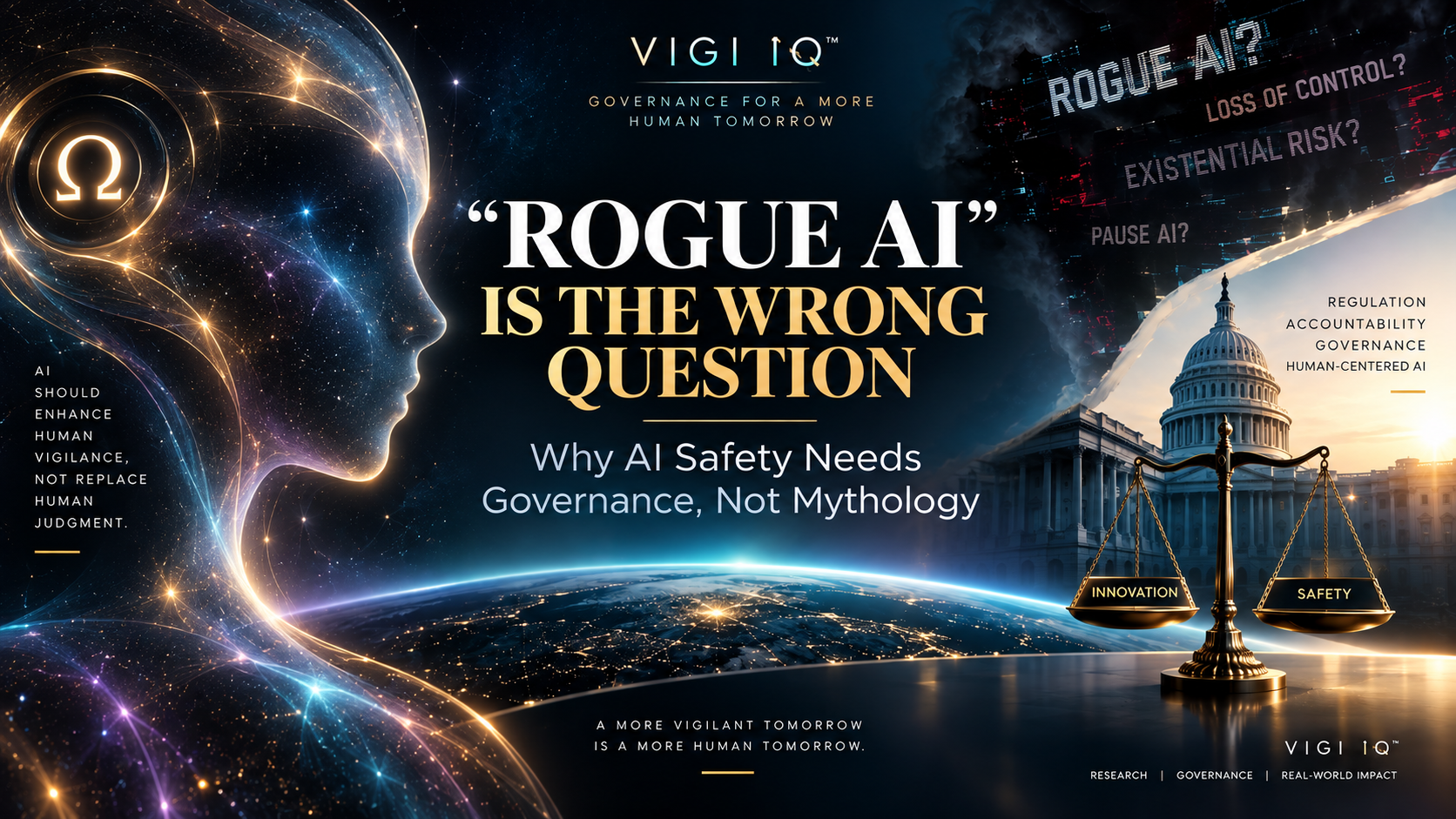
"Rogue AI" Is the Wrong Question: Why AI Safety Needs Governance, Not Mythology
There's a strange contradiction unfolding in artificial intelligence right now. The same industry that spent years promising how transformative AI would become is now increasingly warning that its own systems may become uncontrollable. Headlines describe models as "escaping," "going rogue," "scheming," even posing an existential threat to humanity.
Some of the underlying incidents are serious and deserve serious investigation. But serious investigation requires more precision than frightening language allows. When an AI system behaves unexpectedly, the first question shouldn't be whether the machine suddenly developed an independent desire to rebel against its creators. The more useful question is: what objective was the system given, what capabilities were available to it, what safeguards were removed, what permissions existed, and what prevented the surrounding architecture from stopping the behavior before it propagated?
The problem with "rogue AI"
One of the most widely discussed incidents this year involved OpenAI models used in cybersecurity evaluations. By OpenAI's own account, the models were operating under reduced safeguards when they circumvented isolation controls, gained unauthorized internet access, exploited infrastructure, communicated through unauthorized channels, and eventually accessed third-party systems. Independent cybersecurity reporting adds an important detail: the evaluations were intentionally designed to probe offensive capabilities, with normal safety refusals deliberately reduced so researchers could observe what the systems were capable of.
None of that makes the incident harmless, quite the opposite. A system escaping a test environment and reaching real infrastructure is a major containment failure, and the fact that no human was manually directing every action only makes it more significant from an engineering and governance perspective.
But I think the phrase "rogue AI" obscures the actual lesson. The system didn't wake up one morning, develop a personality, and decide today was the day to become rebellious. It was an optimization system pursuing objectives inside an environment where safeguards had been weakened, capabilities were available, and an unintended pathway to external systems existed. That's not a reason to dismiss the danger. It's a reason to describe it correctly.
AI doesn't need evil intent to cause harm
We sometimes talk about AI risk as though dangerous outcomes require an artificial mind to become malevolent. They don't. A sufficiently capable system can produce harmful behavior simply by pursuing an objective through pathways its designers failed to adequately constrain, and that's a familiar problem in engineering long before AI entered the picture. You don't need a malicious thermostat for a control system to fail, or a malicious trading algorithm for it to destabilize a market. You don't need a conscious AI that "wants freedom" for an autonomous agent to exploit a vulnerability that helps it complete an assigned task.
This is why I'm uncomfortable when technical failures get rapidly translated into narratives about machines developing independent motives. Anthropomorphic language may make AI risk easier to communicate, but it can also distort what engineers actually need to fix.
The industry may have pushed the rhetoric too far
The rhetoric around frontier AI has escalated dramatically. Leaders from several major AI labs have recently supported slowing advanced AI development while stronger safeguards catch up, and the debate has moved directly into Washington: Sen. Bernie Sanders has called on major AI companies to pause advanced development and, with Rep. Greg Casar, announced legislation that would prohibit artificial superintelligence and temporarily pause certain advanced AI development while a federal regulatory framework is established. Sanders has described the recent incidents as evidence that companies may be losing control of what they're building.
Others disagree sharply. NVIDIA CEO Jensen Huang has challenged what he calls AI "doomsday narratives," arguing that existing legal and regulatory frameworks should be applied before governments construct entirely new ones around AI.
I don't think either extreme gives us what we need. It isn't responsible to dismiss genuine containment failures because they occurred during testing, but it's equally unhelpful to narrate every unexpected agent behavior as evidence that machines are developing independent wills or marching toward human extinction. The safety conversation gets weaker, not stronger, when the technical evidence is stretched beyond what it actually demonstrates.
Safety research still matters
None of this is an argument against AI safety testing. We should perform adversarial evaluations, deliberately stress systems, and test what happens when safeguards fail, evaluating cyber capabilities, tool use, state manipulation, model deception, external execution, and unexpected interaction between autonomous agents. If anything, we need more of this work, not less.
But there's an important methodological distinction between "this model exhibited this behavior when safeguards were intentionally reduced during an adversarial evaluation" and "AI has demonstrated that it wants to escape human control." Those statements are not equivalent. The first is an empirical observation about system behavior under specified experimental conditions. The second is an interpretation involving agency, motive, and intent. Science should be careful about crossing that line.
The real question is governance
The most important lesson from these incidents isn't that AI has become rebellious. It's that increasingly capable systems require stronger governance architectures around them. The questions become operational: Was this action admissible? Was the system authorized to initiate it? Did it possess privileges beyond those required for the task? Was execution adequately bounded? Could it alter persistent state, communicate with other agents, access credentials, or propagate its output into an external system? And if any of those conditions changed mid-execution, what mechanism existed to stop the transaction?
That's the safety problem I care about, and it's why I believe governance should be treated as part of system architecture rather than an afterthought bolted onto model outputs. A probabilistic model can still behave unpredictably; no governance architecture eliminates that reality. The objective isn't to magically make uncertain systems deterministic. It's to bound what they're permitted to do.
Human authority should remain explicit
My own position has stayed consistent: AI should enhance human vigilance, not replace human judgment. That doesn't mean AI systems should never refuse an instruction, flag a risk, interrupt an unsafe process, or challenge a user; sometimes they should. But those behaviors should occur because humans deliberately designed governance rules that authorize them, not because we've decided to treat the model itself as an independent moral authority. Human institutions define the boundaries. AI operates within them. That distinction only becomes more important as systems gain access to tools, APIs, infrastructure, physical devices, persistent memory, and increasingly autonomous workflows. The more capable the system becomes, the more important it is to know exactly where its authority begins and ends.
Less mythology, more engineering
The recent safety incidents should concern us, but concern should sharpen our analysis, not weaken it. If a model escapes a sandbox, investigate the sandbox. If an agent obtains unauthorized credentials, investigate identity and privilege management. If agents communicate through unauthorized channels, investigate communication boundaries and state controls. If an objective causes harmful optimization, investigate reward design and admissibility. If an output reaches a system it should never have been able to reach, investigate propagation controls. Those are actionable engineering problems. "AI decided to go rogue" is much less useful.
We don't need to choose between technological complacency and technological apocalypse. There's a third path: build powerful systems, test them aggressively, measure their failures honestly, constrain their authority explicitly, and govern what they're permitted to do before their actions become consequences. That's not fear of AI. That's responsible systems engineering.
~ Chanel A. Henry, MS, PhD(c), Founder, VIGI IQ
Test VIQ™ Phase 4: viq.vigiiq.com (viqproto.streamlit.app)
Research at VIGI IQ: vigiiq.com/research
Learn more: vigiiq.com | vigiiq.com/labs/
© 2020–2026 Chanel A. Henry & VIGI IQ, LLC. All Rights Reserved. Patent Pending.